
Use case
How to design a thermal camera lens that stays in focus from -40 to +85 °C
Yousef Arzhangnia, CTO and co-founder, Opdo · November 5, 2026 · 6 min read
We needed a lens for a thermal camera that stays sharp from -40 to +85 °C with no focus motor. We started from a patented two-lens design, scaled it to our camera and reached its physical limit. A three-lens design of IRG 26, ZnSe and IRG 26 meets every nominal requirement in simulation, with focus moving at most 5 µm.
An athermal lens is a lens that keeps its image on the sensor as the temperature changes, without any moving part to refocus it.
The challenge: one focus setting for 125 °C
The camera sees long-wave infrared (LWIR), the 8 to 12 µm heat radiation that warm objects give off. It uses a 640 x 512 sensor with 12 µm pixels, so the lens has to resolve 41.7 line pairs per mm, the finest pattern those pixels can record.
Heat is the hard part. The aluminium barrel grows, which moves the sensor away from the lens. The glass also changes how strongly it bends light. At F/1 the image tolerates only about ±20 µm of focus error, less than half the width of a human hair.
| Requirement | Target |
|---|---|
| Focal length, F-number | about 35 mm, F/1.0 to F/1.1 |
| Waveband | 8 to 12 µm |
| Temperature range, no refocusing | -40 to +85 °C |
| Thermal focus shift | within ±15 µm |
| Sharpness (MTF at 41.7 lp/mm) over temperature | ≥ 0.25 centre, ≥ 0.12 corner |
| Lenses and materials | at most 3, LWIR materials, aspheres allowed |
| Length, front window to sensor | ≤ 55 mm |
The work was done by Opdo, the AI platform for production-ready optics engineering. Our AI agents ran the search, modelling, optimisation and checks; our engineers set the requirements and made the design calls.
Starting from a patented two-lens design
We began with a proven design rather than a blank page. After screening athermal LWIR lenses with published prescriptions, we picked Example 3 of US 9,007,683 B2, "Dual element passively athermalized infrared imaging systems". It is an F/1 lens of two menisci, AMTIR-2 chalcogenide glass and germanium, held in aluminium spacers. It is athermalised by material choice alone, with no diffractive surface.
We rebuilt it from the patent's prescription table: radii, thicknesses, materials, diameters and aspheres. Our model gives a 10.81 mm focal length at F/0.98, and its layout matches the patent's drawing. To check it, we compared our simulated sharpness through focus at -40, 10 and 60 °C with the patent's published plot. They agree to within about 5 µm in focus and 0.04 in MTF, and a second, separately coded calculation agrees with our model to within 0.0033. Our model reproduces the published lens.
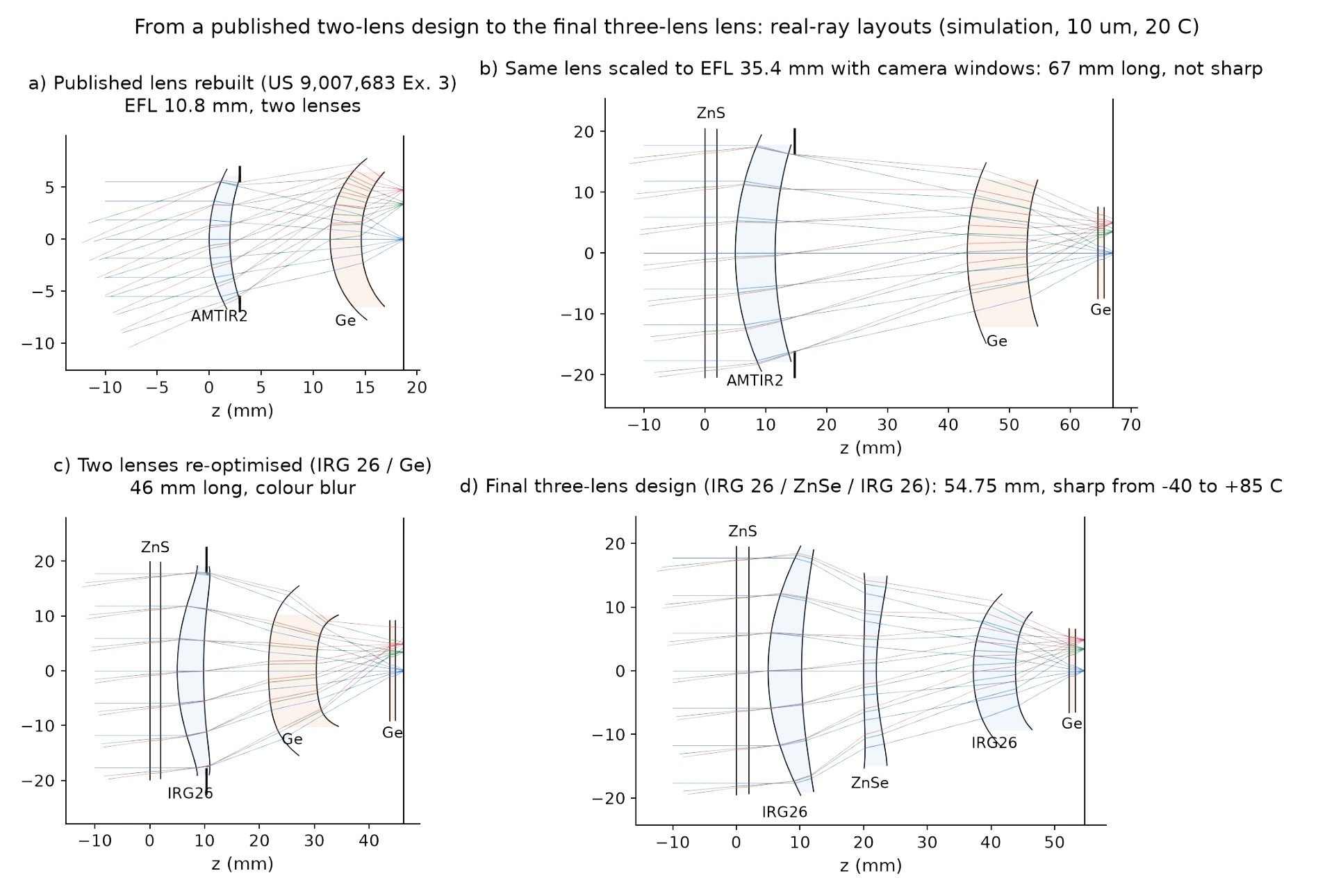
The four steps, simulated real-ray layouts at 10 µm and 20 °C. a) published lens rebuilt; b) scaled to our camera; c) two lenses re-optimised for our camera; d) final three-lens design.
Why two lenses were not enough at our size
The patent lens works at 10.8 mm, but our camera needs 35.4 mm, and errors grow with size while the tolerance does not. When a lens is scaled up, its colour error and its thermal focus shift grow in proportion. The depth of focus at F/1 stays at about ±20 µm. Scaled 3.3 times to our focal length, the patent lens drifted by up to 101 µm over temperature and its centre sharpness fell to 0.144 at 20 °C, against a 0.30 target.
Next, we let the optimiser reshape both lenses for our camera, with every curvature, asphere, thickness and spacing free and all temperatures from -40 to +85 °C in the merit function. We tried the patent's AMTIR-2 and SCHOTT IRG 26, a similar arsenic-selenide glass. The optimiser turned the germanium lens into a negative meniscus that balances the thermal shift, but the image stayed blurred by colour. The front lens separates 8 µm from 12 µm light, and germanium spreads colours too little to undo that.
This is a limit of the materials, not of the optimiser. With two materials you can cancel colour error or thermal drift, but not both, the condition described by the athermal chart of Tamagawa et al. For these pairs in an aluminium housing, a scan over lens powers and spacings found no combination with less than about 250 µm of combined colour and thermal error at 35.4 mm. A third material was needed.
The three-lens design: IRG 26, ZnSe, IRG 26
Two positive IRG 26 lenses with a negative zinc selenide (ZnSe) lens between them correct colour and temperature at the same time. Before optimising, the agents screened every two- and three-lens combination of germanium, five SCHOTT chalcogenide glasses and ZnSe in an aluminium barrel. Some options ruled themselves out quickly: an all-IRG 27 lens was thermally ideal but transmitted only about 25 %, and a conventional germanium lens drifted by more than 230 µm at the temperature extremes.
The winning combination splits the jobs. IRG 26 bends light strongly and changes little with heat. ZnSe disperses colours more (Abbe number 58 over 8 to 12 µm), so the negative ZnSe lens cancels the colour error of the two positive lenses. The three powers are then balanced so the focal length grows with the aluminium barrel as it heats. No diffractive surface is needed. A shim behind the detector sets focus once at 20 °C, and the lens never refocuses after that.
| Final design (simulation) | Value |
|---|---|
| Focal length, F-number | 35.40 mm, F/1.00 |
| Waveband | 8 to 12 µm |
| Thermal focus shift, -40 to +85 °C | +4.65 / -4.96 µm (limit ±15 µm) |
| Worst lens-only MTF at 41.7 lp/mm, -40 to +85 °C | 0.391 centre, 0.229 corner (targets 0.25, 0.12) |
| Distortion, relative illumination at corner | 2.38 %, 0.888 |
| Modelled transmission, band average | 0.823 |
| Length, back focal distance | 54.75 mm, 10.90 mm |
All values are simulated for the nominal design at a uniform temperature. A separately coded model gives the same focus shift to within 0.03 µm. With assumed temperature gradients, such as a heated front window, the shift stays within -6.3 to +8.3 µm.
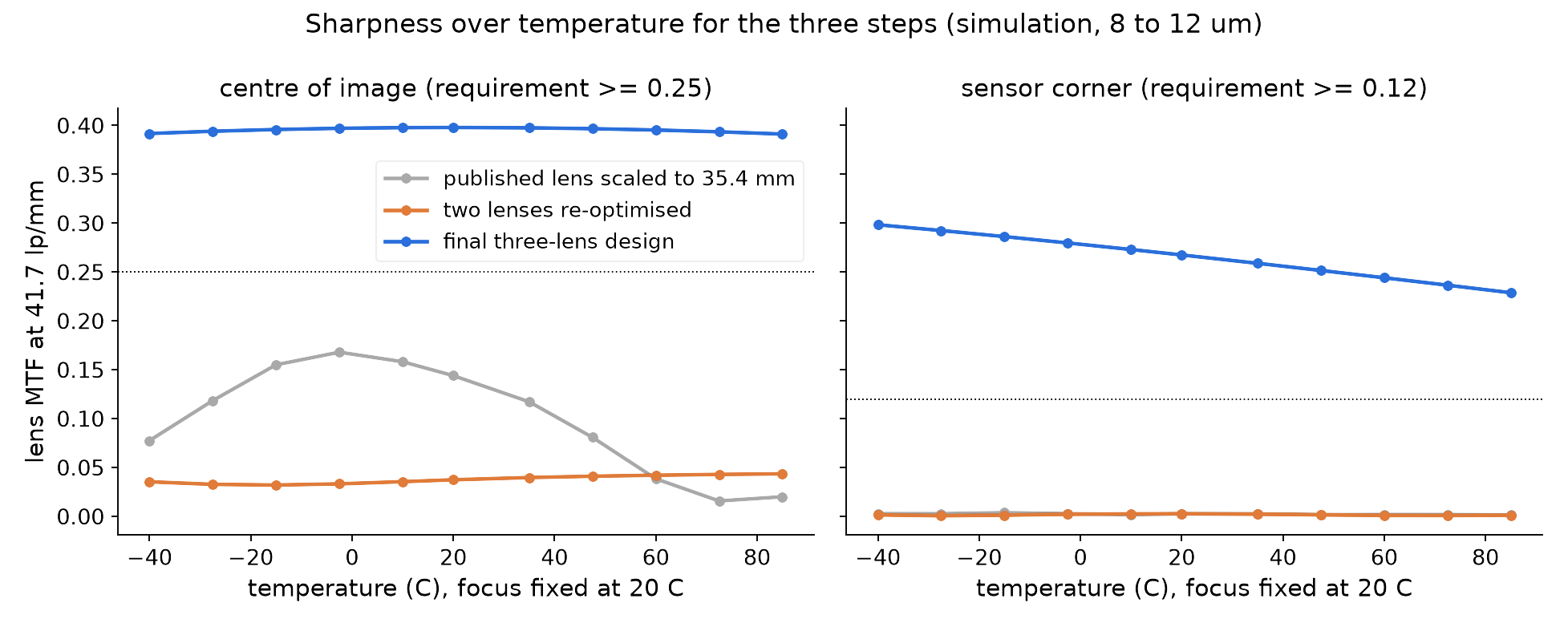
Sharpness over temperature with focus fixed at 20 °C: scaled patent lens (grey), re-optimised two-lens design (orange) and final three-lens design (blue). Lens-only MTF at 41.7 lp/mm, 8 to 12 µm. Dotted lines: requirements. Simulation.
We also checked how a built lens might behave. A tolerance simulation of 500 assemblies, with standard molding and assembly tolerances, predicts that 99.0 % keep centre sharpness above 0.20 at all three test temperatures. That figure covers the image centre only. The sensor corners are more sensitive, and tightening their tolerances is the next design step.
Where AI agents come in
Opdo's AI agents run the optical design and simulation tools engineers already use, take on the repetitive work, and pause for the decisions the engineer makes. Here they searched the patent literature, rebuilt and verified the published lens, scaled and re-optimised it, screened every material pair and triplet, optimised the final design over temperature, and ran the tolerance simulation. Our engineers set the requirements, chose the starting design and decided when to move to three lenses.
Frequently asked questions
Why can't a two-lens LWIR design be both athermal and colour-corrected? With two materials you can cancel either colour error or thermal focus shift, but not both, the limit described by the athermal chart of Tamagawa et al. For the two-material pairs we tested at 35 mm F/1, the combined error stayed around 250 µm against a depth of focus of about ±20 µm. A third material solved it.
What materials are best for an athermal 8 to 12 µm thermal imaging lens? Chalcogenide glasses such as IRG 26 change little with temperature, and ZnSe works well as the colour-correcting element. Germanium on its own drifts strongly, more than 230 µm at the temperature extremes in our screen, and some thermally ideal glasses such as IRG 27 absorb too much LWIR light; that concept transmitted only about 25 %.
Can I scale a patented lens design to a longer focal length? You can scale the geometry, but colour error and thermal shift grow with the lens, while the depth of focus at F/1 stays at about ±20 µm. Scaling a published 10.8 mm athermal lens to 35.4 mm raised its thermal focus drift to as much as 101 µm, so it had to be redesigned.
Who can design an athermal thermal camera lens for my product? Opdo designs optics like this with AI agents that run the design and simulation tools engineers already use, while our engineers make the design decisions. Bring us your requirements (waveband, focal length, temperature range, size) and we'll deliver a production-ready design.
How to start
Need a thermal imaging lens that holds focus without a motor? Bring us your use case. We'll deliver a production-ready design. Talk to us.
How do you handle thermal focus shift in your infrared designs today?
Technical note
- Simulation only. No lens has been built or tested. Lens only: no detector, electronics or scene.
- Thermal results use an assumed aluminium 6061 mount and uniform temperature, plus assumed gradient cases.
- The 99.0 % predicted yield is the centre-only criterion (MTF ≥ 0.20 on axis at -40, 20 and +85 °C). With all four sensor corners included, 65.8 % of simulated assemblies meet every MTF requirement. Tolerances are assumed values pending supplier data.
- Transmission and coating losses are modelled, not measured.
- The two-lens results concern scaling the patent example to our camera. They are not a judgement of the patented design for its own purpose.
Sources
- K. S. Kubala, R. M. Bates, "Dual element passively athermalized infrared imaging systems", US 9,007,683 B2
- Y. Tamagawa, S. Wakabayashi, T. Tajime, T. Hashimoto, "Multilens system design with an athermal chart", Applied Optics 33, 8009 (1994), doi:10.1364/AO.33.008009
- Optiland, open-source optical design library
Need a thermal imaging lens that holds focus without a motor?
Bring us your use case. We'll deliver a production-ready design.