
AI Engineering
AI-native optical engineering.
AI that runs your design and simulation work in Zemax, CODE V, FRED, Lumerical, COMSOL and the other tools you already use, and optical engineers who use it on your project when you need them.
The challenge today
Every change means hours of runs and weeks of waiting.
When time is short, quality takes a hit. Long simulation runtimes force optical engineering teams to trade off model accuracy to stay on schedule.1
Design
AI fluent in the tools you already design with.
Give it your requirements and constraints. It sets up the whole design process in your preferred design software: merit functions, starting points, the runs and the bookkeeping. Your problem shapes the optimizer recipes.
- It asksMissing specs, datasheets, constraints. Then it writes the requirements for you to confirm.
- It plansIt lays out a plan with checkpoints, such as the spot size or MTF a promising design should reach at each stage. You know early whether a direction is working.
- It checks as it goesLike an engineer, it reviews ray fans, aberrations, MTF and spot sizes throughout the design and changes course when something drifts.
- It explains every stepEach design choice and optimizer change comes with a plain-language reason, so you can follow, question or override it. You also get the design files to rerun any result yourself, and an independent agent reviews the final design.
What the AI agents do, from requirement to handoff.
01 · Define
Requirement capture
Turns goals and constraints into a quantified spec, with hidden assumptions and missing parameters found up front.
02 · Define
Requirements to quote
Turns a request or spec sheet into a first concept, scope and manufacturing estimate.
03 · Design
Design exploration
Compares candidate architectures across imaging, illumination, freeform and photonic designs.
04 · Design
Lens design optimization
Optimizes for field of view, resolution, working distance and package.
05 · Design
Solver orchestration
Runs ray, wave and photonic solvers as one workflow.
06 · Analyze
Multi-physics simulation
Adds thermal and mechanical behavior where the design needs it.
07 · Analyze
Tolerancing and yield
Tests sensitivity to fabrication, assembly and environment.
08 · Analyze
Stray light and ghosts
Traces ghost reflections, scatter and veiling glare.
09 · Analyze
Design review
Reviews a design for performance, manufacturability and gaps.
10 · Make
Design for fabrication
Matches the design to process limits, materials and inspection.
11 · Make
Metrology feedback
Compares measured parts with design and simulation.
Optical engineer on call
Need more hands? Our engineers work in the same setup.
Our optical engineers use the same AI on your project. No handover to a different system, no new tools on your side. You stay the lead engineer.
More hands
A deadline your team can't make alone. We take on single analyses or whole subsystems.
A second pair of eyes
A review before fabrication, covering performance risks, manufacturability and gaps in the spec.
The whole design
From requirements to a production-ready design, with the decisions that stay with you agreed up front.
Custom AI tools
Custom AI tools, built for your optics.
If your team designs variants of the same kind of system, the tools should know them. We adapt them to your past designs, your standards and your suppliers' limits, and test them on your own cases before you rely on them.
Built on your work.
Trained on your past designs and standards, so it starts where your team already is.
Proven before you rely on it.
Tested on your own past cases first. You see where it is right before it touches a live project.
Runs where you want.
In our cloud, yours or on-prem.
The tool and the model are yours. We never train on your data without your say.
Scope your custom AI tool →Manufacturability
Manufacturable from the first design.
Every design is checked the way a fabricator will see it, and with the suppliers who will make it, before it leaves your desk.
| Check | What we do | What you get |
|---|---|---|
| Tolerancing and yield | Budget tolerances against predicted production yield | Tolerance budgets and worst-case performance |
| Design for fabrication | Match surfaces and materials to the chosen process | A design your supplier can make and inspect |
| Thermal, mechanical, stray light | Simulate where it matters | Failure modes found before fabrication |
| Supplier review | Review the design with the suppliers who will make it | Fabrication feedback before you commit |
| CAD fit and handoff | Check the optics against your mechanical CAD | ISO 10110 drawings, STEP, ZMX and SEQ files ready to quote |
Never restart a design cycle because it is not manufacturable.
Training data
For cameras and sensors: training data from your actual lens.
Perception models fail on what renderers can't produce: flare, ghosts, glare, low light, weather. We trace synthetic training data through your exact lens, coatings and sensor.
The edge cases your fleet can't collect safely.
| What breaks models | What we simulate | Traced through |
|---|---|---|
| Sun into the lens, headlights at night | Ghost images, flare and veiling glare | Your lens prescription, coatings and housing |
| Dusk, tunnels, dark warehouses | Photon noise, read noise, quantum efficiency | Your sensor, pixel by pixel |
| Rain, fog, dirty windows | Scattering and contrast loss as propagation physics | The medium between scene and lens |
| Wide angles, close range | Distortion, vignetting, defocus across the field | Your exact optical design |
How a dataset is made.
- Your cameraWe model the lens, coatings, housing and sensor, from your design files or the one we designed with you.
- Your scenesThe environments and conditions your system has to handle.
- At scaleGPU runs sweep sun angle, weather, exposure and sensor variants into images and video.
- Ground truthLabels come from the simulation with every frame, so nothing is annotated by hand.
- MeasuredA pilot dataset against your current training pipeline, so you see the difference in your own metrics.
For autonomy and driver assistance, robotics and warehouse automation, and inspection systems.
Proof
One project, in numbers.
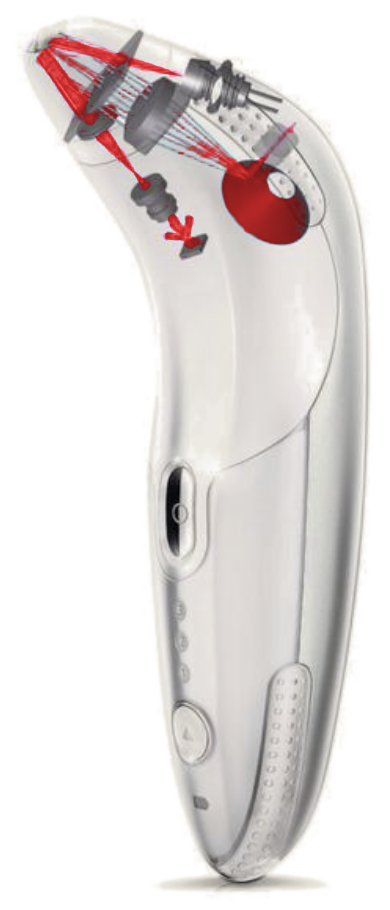
Beam conditioning for a CO₂ surgical laser with interchangeable handpieces: every laser has to deliver the same beam to every handpiece.
Questions
Frequently asked questions about AI for optical design.
What is AI-native optical engineering?
AI-native optical engineering means optical systems are designed by AI agents that run industry simulators such as Zemax and CODE V, supervised by optical engineers who make the decisions. Opdo, based in Los Angeles, works this way from requirements to verified parts.
How does AI work with Zemax and CODE V?
Opdo's AI agents drive Zemax OpticStudio, CODE V, FRED and other simulators directly: they set up the runs, execute them and check the results, and the engineer approves each step. Your files and workflow stay the same.
Can AI design optical systems reliably?
Yes, when every result is computed in a real simulator and checked. Opdo's AI marks quick estimates as provisional, confirms results with logged runs, cross-checks them with a second method and an independent agent, and records every decision.
Why not just ask a general AI chatbot?
A general chatbot answers from memory. Opdo's AI runs the simulators and checks the result.
| A general AI chatbot | Opdo | |
|---|---|---|
| Missing specs | Fills them in silently | Negotiates before it calculates |
| Simulation | Estimates from memory | Runs Zemax, CODE V, FRED and others |
| Rough numbers | Presented as answers | Marked provisional until a logged run |
| Checking | None | A second method and an independent agent |
| Manufacturing | Not considered | Checked against process limits and tolerances |
| Record | A chat history | An audit trail of every decision |
Opdo doesn't ask you to trust the AI. Every decision is yours, and every output is grounded in the simulators you already trust.
Does AI replace optical engineers?
No. The AI handles setup, runs and bookkeeping; the optical engineer makes the design decisions. When a team needs more capacity, Opdo's own optical engineers work on the project with the same tools.
Is my optical design data used to train AI models?
No. With Opdo, designs stay in your network and are never used for training without your consent. A custom AI tool or model Opdo builds for you belongs to you.
What kinds of optics can Opdo design?
Opdo designs laser systems, imaging and camera optics, AR/VR optics and waveguides, micro-optics and nanostructured surfaces, from first concept to a production-ready, manufacturable design.
Do optical engineers need to learn prompt engineering?
No. Engineers brief Opdo's AI in plain sentences, like a colleague, and the AI asks for whatever is missing before it calculates.
How do I start an optical design project with Opdo?
Book a call with an Opdo engineer about one concrete optical problem. From there, you get a demo on your own design or a scoped first project, with no long-term commitment.
What are you building?
Tell us about your optical problem. We'll show you where Opdo fits.